AI.zip
  • AI 모델
  • 방법론
  • AI 서비스
  • 가격 비교
  • 블로그

AI.zip

AI 모델, 서비스, 방법론을 큐레이션하는 에디토리얼 플랫폼

탐색

  • AI 모델
  • AI 서비스
  • 방법론
  • 블로그

커뮤니티

  • 소개
  • 디스코드 참여
  • 문의

법적고지

  • 이용약관
  • 개인정보처리방침

© 2026 ai.zip. All rights reserved.

Discord 커뮤니티
블로그Auto Research vs AutoML: LLM 자율 연구와 자동 ML의 핵심 차이

Auto Research vs AutoML: LLM 자율 연구와 자동 ML의 핵심 차이

비교
2026년 4월 6일약 14분

Auto Research vs AutoML: Why LLM-Driven Research Is a Different Category

COMPARISONAuto ResearchAutoMLLLM AgentAI Scientist

Auto Research vs AutoML: Why LLM-Driven Research Is a Different Category

AutoML automates hyperparameter search within predefined spaces, but Auto Research uses LLMs to generate novel hypothese

youtube.com

핵심 포인트

  • 1.Auto Research vs AutoML: 코딩이면 Auto Research, 파라미터 튜닝이면 AutoML 결론부터 말하면, Auto Research는 AutoML의 상위 호환이 아니다
  • 2.완전히 다른 카테고리의 도구다
  • 3.AutoML이 "사전에 정의된 탐색 공간 안에서 최적 파라미터를 찾는 자동화"라면, Auto Research는 "LLM이 스스로 가설을 세우고 코드를 작성하고 실험을 반복하는 자율 연구"다

Auto Research vs AutoML: 코딩이면 Auto Research, 파라미터 튜닝이면 AutoML

결론부터 말하면, Auto Research는 AutoML의 상위 호환이 아니다. 완전히 다른 카테고리의 도구다. AutoML이 "사전에 정의된 탐색 공간 안에서 최적 파라미터를 찾는 자동화"라면, Auto Research는 "LLM이 스스로 가설을 세우고 코드를 작성하고 실험을 반복하는 자율 연구"다. 2026년 3월 Andrej Karpathy가 630줄짜리 Python 스크립트 하나로 하룻밤 동안 50개 실험을 자동 실행한 AutoResearch를 공개하면서, 이 차이가 업계에서 본격적으로 논의되기 시작했다. 학습 전략을 바꾸거나 Flash Attention 같은 아키텍처 변경을 시도하는 것은 AutoML의 탐색 공간에는 존재하지 않는 영역이다. 반면, 이미 검증된 파이프라인에서 learning rate를 0.001로 할지 0.003으로 할지 빠르게 정해야 하는 프로덕션 환경에서는 AutoML이 여전히 정답이다.

한눈에 보는 비교
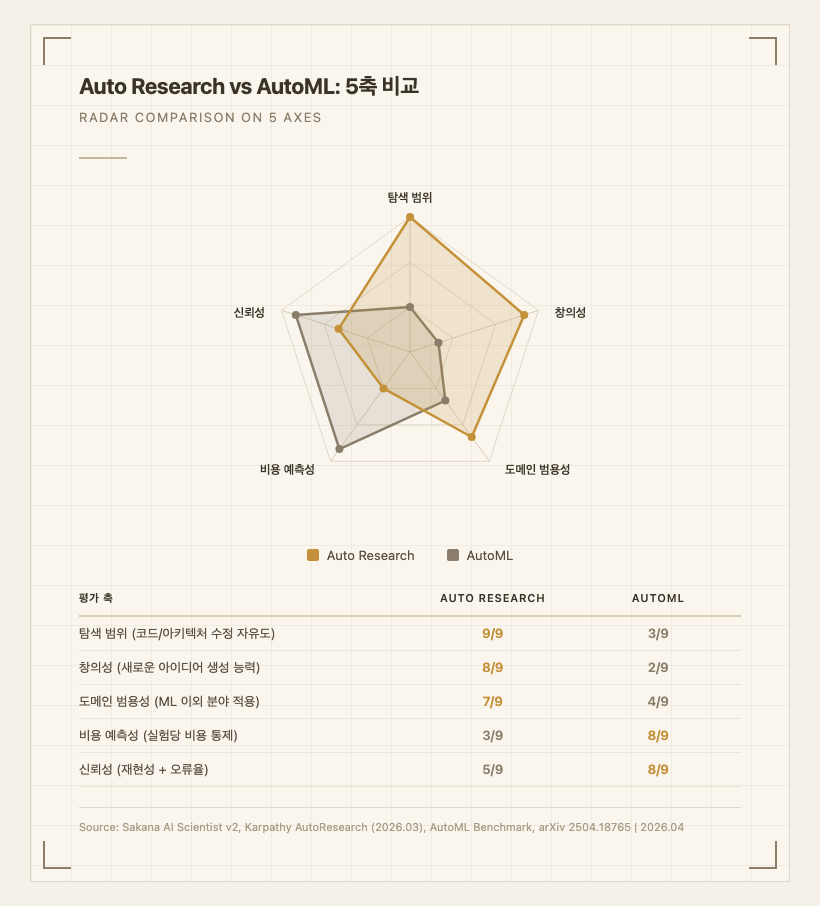
Auto Research vs AutoML 5축 레이더 비교

위 레이더 차트는 5개 축에서 Auto Research와 AutoML의 강약 패턴을 보여준다. 각 축의 점수 산출 근거는 다음과 같다.

탐색 범위 - Auto Research 9/9 vs AutoML 3/9. AutoML(Optuna, Ray Tune, Auto-Keras 등)은 사용자가 trial.suggest_float("lr", 1e-5, 1e-2) 같은 형태로 미리 정해준 파라미터 공간만 탐색한다. Auto Research는 LLM이 train.py 파일 자체를 수정하기 때문에 optimizer 변경, 새로운 regularization 기법 도입, 심지어 모델 아키텍처 재설계까지 시도할 수 있다. Karpathy의 AutoResearch는 실제로 하룻밤 실험에서 Cosine Annealing 도입, Gradient Clipping 추가, Muon optimizer 적용 등 코드 수준 변경을 자율적으로 수행했다. (출처: Karpathy GitHub, MarkTechPost 2026.03)

창의성 - Auto Research 8/9 vs AutoML 2/9. AutoML의 탐색 알고리즘(베이지안 최적화, 유전 알고리즘)은 주어진 공간 내에서 효율적으로 탐색하지만, "Gradient Clipping을 추가하면 어떨까?"라는 아이디어를 생성하지 못한다. Auto Research의 LLM은 수백만 논문의 지식을 바탕으로 새로운 조합을 제안한다. EvoScientist(2026.03)는 자동 생성 아이디어의 참신성(novelty)에서 7개 기존 시스템을 초과했다는 벤치마크 결과를 보고했으며, DeepResearch Bench II와 AstaBench에서 1위를 기록했다. (출처: arXiv 2603.08127)

도메인 범용성 - Auto Research 7/9 vs AutoML 4/9. AutoML은 ML 파이프라인(분류, 회귀, NAS)에 특화되어 있다. Auto Research 시스템은 ML 이외 분야에서도 작동한다. Kosmos(2025.11)는 데이터셋과 목표만 주면 12시간 동안 200개 에이전트 롤아웃을 실행하면서 평균 42,000줄의 코드를 실행하고 1,500편의 논문을 읽었다. 독립 과학자 평가에서 Kosmos 보고서 내 진술의 79.4%가 정확하다고 판정했다. (출처: arXiv 2511.02824)

비용 예측성 - Auto Research 3/9 vs AutoML 8/9. AutoML은 trial 수와 GPU 시간을 사전에 정할 수 있어 비용이 예측 가능하다. Auto Research는 LLM API 호출 비용이 실험 복잡도에 따라 크게 변동한다. Karpathy 루프는 실험당 정확히 5분으로 시간을 고정해서 이 문제를 부분적으로 해결했지만, LLM 토큰 소비량은 실험마다 다르다.

신뢰성 - Auto Research 5/9 vs AutoML 8/9. AutoML은 deterministic 알고리즘 기반으로 동일 입력에 동일 결과를 보장한다. Auto Research의 LLM은 비결정론적(non-deterministic)이라 같은 가설이 매번 다른 코드를 생성한다. Sakana AI Scientist v2의 독립 평가에서 42%의 실험이 코딩 오류로 실패했다는 결과가 보고되었다. 또한 잘 알려진 기법(예: SGD 미니배치)을 "새로운 아이디어"로 잘못 분류하는 참신성 평가 오류도 확인되었다. (출처: arXiv 2502.14297)

항목별 상세 비교

작동 방식: 탐색 공간 vs 자유 코드 수정

AutoML의 핵심은 사전 정의된 탐색 공간(search space) 내 최적화다. 사용자가 batch_size를 [16, 32, 64, 128] 중에서 고르도록 정하면, 베이지안 최적화나 TPE(Tree-structured Parzen Estimator)가 그 범위 안에서 최적값을 찾는다. 이 방식은 탐색 공간 정의만 잘하면 안정적이지만, 탐색 공간 밖의 해결책은 영원히 찾지 못한다.

Auto Research는 LLM에게 train.py 같은 단일 파일을 통째로 수정할 권한을 준다. Karpathy의 AutoResearch에서 에이전트는 program.md 파일의 지시를 읽고, 코드를 수정하고, 5분간 학습을 돌리고, validation loss가 개선되면 커밋하는 루프를 반복한다. 이 "래칫(ratchet) 루프"에서 loss가 악화된 변경은 자동으로 폐기되고, 개선된 변경만 누적된다. 시간당 약 12개 실험, 하룻밤이면 약 100개 실험이 가능하다. (출처: The New Stack, DataCamp 2026.03)

실무적 차이는 크다. AutoML에게 "Flash Attention을 적용해봐"라고 요청할 방법은 없다. 하지만 Auto Research의 LLM은 GPU 메모리 부족 에러를 보고 스스로 Flash Attention 코드를 작성하는 것이 가능하다.

연구 자동화 범위: 파라미터 최적화 vs 논문 작성

AutoML이 담당하는 영역은 ML 워크플로우의 마지막 10-18%에 해당한다. Delphina의 분석에 따르면, 데이터 과학자가 모델 선택과 학습에 쏟는 시간은 전체의 18%에 불과하며, 나머지 82%는 문제 정의, 데이터 전처리, 피처 엔지니어링, 결과 해석에 사용된다. AutoML은 이 18%를 자동화하고, 나머지는 건드리지 않는다. (출처: Delphina "Why AutoML Failed to Live Up to the Hype")

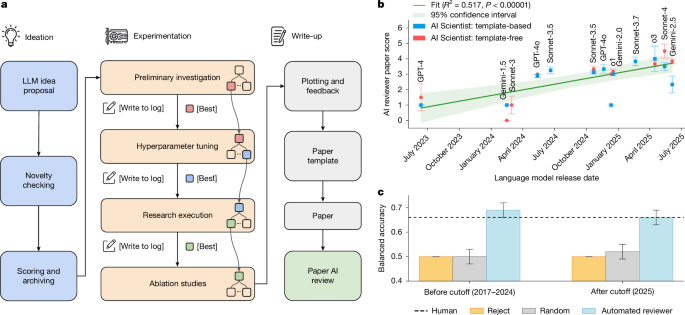
Auto Research 시스템들은 연구 전체 라이프사이클을 자동화하려 한다. AI Scientist v2(Sakana AI, 2025.04)는 아이디어 생성부터 코드 작성, 실험, 논문 작성, 자동 리뷰까지 수행한다. 실제로 3편의 완전 자율 논문을 ICLR 워크숍에 제출했고, 그 중 1편은 평균 리뷰어 점수 6.33을 받아 상위 45%에 해당하는 수준을 달성했다. 이 논문이 인간이 작성한 것이었다면 수락되었을 것이라는 평가를 받았으며, 이것은 완전 AI 생성 논문이 피어리뷰를 통과한 최초 사례로 기록되었다. 이 연구는 2026년 3월 Nature에도 게재되었다. (출처: Sakana AI Scientist v2 Paper, Nature 2026.03)

AI-Researcher(NeurIPS 2025 Spotlight)는 문헌 리뷰부터 알고리즘 구현, 출판 가능 수준의 원고 작성까지 최소한의 인간 개입으로 수행하는 시스템이다. EvoScientist(2026.03)는 여기에 진화적 자기개선을 더했다. Researcher Agent, Engineer Agent, Evolution Manager Agent 3개의 에이전트와 6개의 서브 에이전트가 협력하며, 이전 실험에서 배운 전략을 영구 메모리에 저장해 다음 실험에 재활용한다. (출처: arXiv 2603.08127, arXiv 2505.18705)

비용 구조: 예측 가능한 GPU vs GPU + LLM API
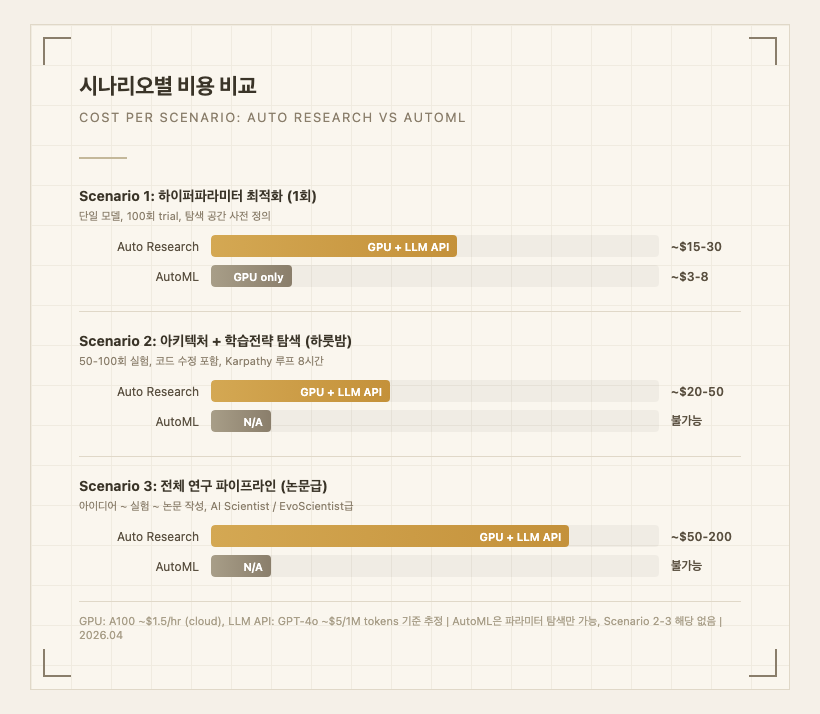
시나리오별 비용 비교

AutoML의 비용은 GPU 컴퓨팅에 집중된다. 100회 trial을 A100에서 돌리면 대략 $3-8 수준이고, trial 수를 늘려도 선형적으로 예측 가능하다. 숨겨진 비용이 거의 없다.

Auto Research는 GPU 비용에 LLM API 비용이 추가된다. Karpathy 루프에서 각 실험마다 LLM이 코드를 분석하고 수정 방향을 제안하고 코드를 생성하는 과정에서 수천-수만 토큰을 소비한다. 하룻밤 100회 실험이면 GPT-4o 기준 대략 10−30의API비용이추가로발생한다.AIScientistv2같은전체파이프라인은논문1편당10-30의 API 비용이 추가로 발생한다. AI Scientist v2 같은 전체 파이프라인은 논문 1편당 10−30의API비용이추가로발생한다.AIScientistv2같은전체파이프라인은논문1편당50-200 수준으로 추정된다.

반면, AutoML이 아예 할 수 없는 작업(아키텍처 탐색, 전체 연구 자동화)에서는 비용 비교 자체가 성립하지 않는다. 인간 연구자가 동일 작업을 수행하는 비용과 비교해야 한다. Kosmos의 독립 평가에서 협력 연구자들은 "단일 20사이클 실행이 자신들의 평균 6개월 연구량에 해당한다"고 보고했는데, 이를 연구원 인건비로 환산하면 Auto Research의 $50-200은 파격적으로 저렴한 셈이다.

한국어 사용자 관련 참고

Auto Research와 AutoML 모두 한국어 사용자에게 특별한 장벽이 있지는 않다. AutoML 도구(Optuna, Auto-Keras, H2O)는 글로벌 오픈소스 프로젝트로 한국어 문서화는 제한적이지만, API 자체가 언어 무관하다. Auto Research 시스템의 경우, LLM이 영어 논문 지식을 기반으로 작동하므로 program.md를 영어로 작성하는 것이 권장된다. Karpathy의 AutoResearch는 MIT 라이센스 오픈소스로 국내에서도 바로 사용 가능하다. 국내 Auto Research 활용 사례는 2026년 4월 현재 공개적으로 확인된 것이 없다.

실사용자는 뭐라고 하나

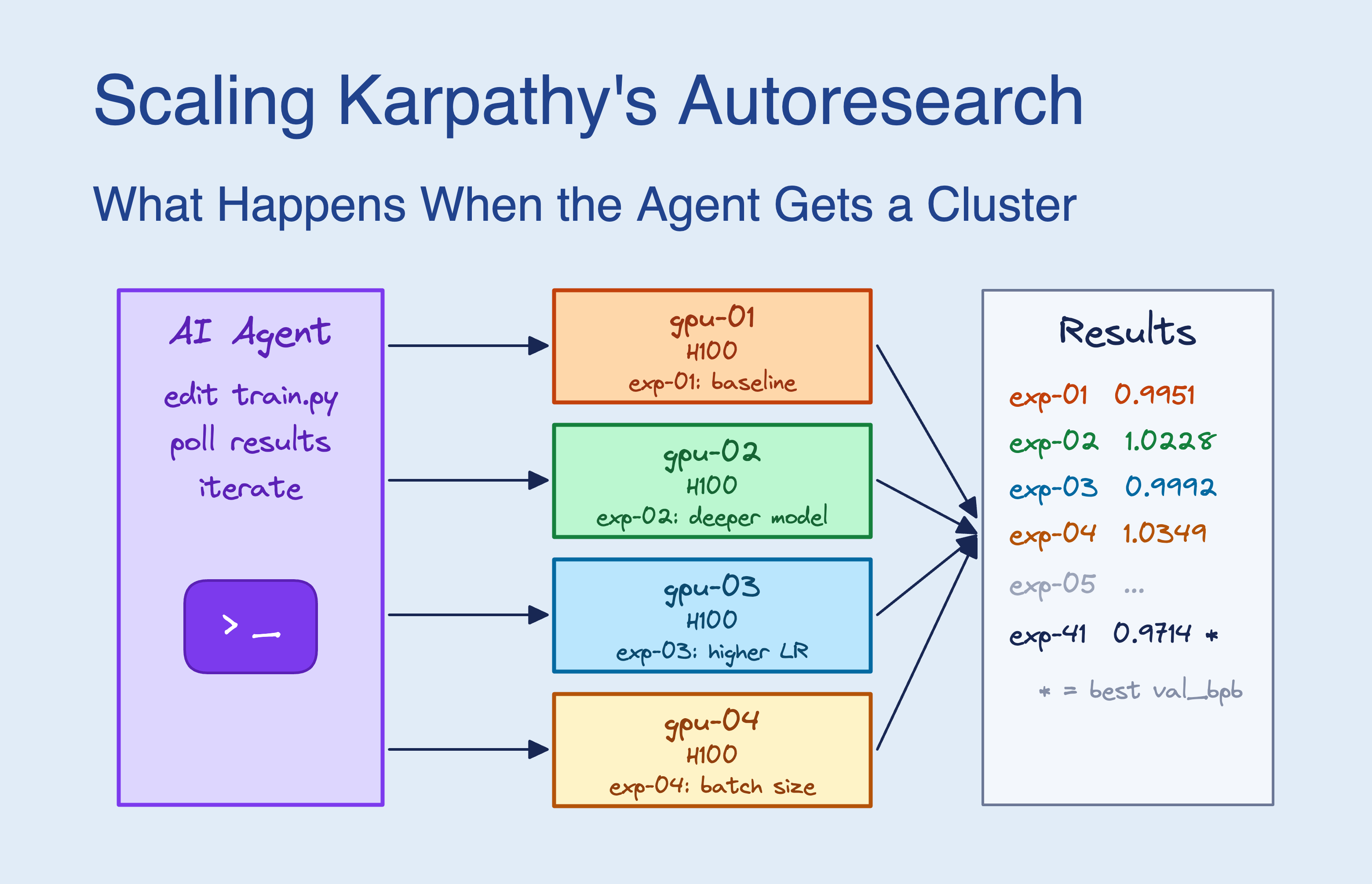
Reddit r/MachineLearning 커뮤니티 반응. Karpathy의 AutoResearch 공개 직후 Reddit에서 상당한 논의가 이루어졌다. SkyPilot 블로그에서는 "단일 GPU 제약을 벗어나 GPU 클러스터로 확장하면 어떻게 되는가"를 실험해서 공유했다. 핵심 반응은 "5분 고정 시간이 실험 간 공정한 비교를 가능하게 한다"는 점에 대한 긍정과, "5분으로는 대형 모델 실험이 불가능하다"는 한계 지적이 공존했다. (출처: SkyPilot Blog, Reddit)

AI Scientist에 대한 학계 반응. Sakana AI Scientist v2가 ICLR 워크숍 피어리뷰를 통과한 것에 대해, arXiv에 독립 평가 논문(2502.14297)이 제출되었다. 제목 자체가 "Bold Claims, Mixed Results, and a Promising Future?"로, 기대와 우려를 동시에 반영한다. 독립 평가자들은 42% 실험 실패율, 문헌 리뷰의 표면적 키워드 검색 의존, 참신성 평가 오류를 지적했다. 하지만 "이 방향 자체가 유망하며 앞으로 빠르게 개선될 것"이라는 전망도 제시했다. (출처: arXiv 2502.14297, ACM SIGIR Forum)

AutoML 회의론. Delphina의 "Why AutoML Failed to Live Up to the Hype" 분석에서는 AutoML이 ML 워크플로우의 극히 일부만 자동화하며, 실제 데이터 과학자의 업무에서 차지하는 비중이 제한적이라는 점을 지적했다. Google AutoML에 대해서도 "학술 연구실이 영리 기업에 내장되면서, 실제 필요를 충족하는지보다 연구 결과를 제품화하려는 유인이 작동한다"는 비판이 있었다. HBR도 "AutoML의 리스크"를 다루며 블랙박스 특성과 과적합 위험을 경고했다. (출처: Delphina Blog, Harvard Business Review, fast.ai)

누가 뭘 쓰면 되나 (Editor's Pick)
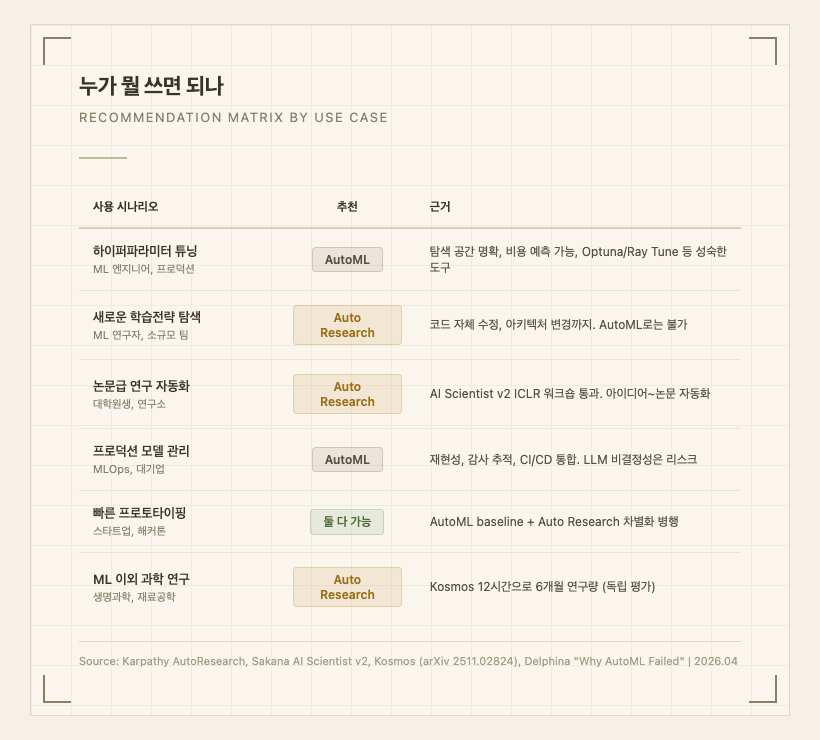
추천 매트릭스

명확한 승자 선언: 연구자라면 Auto Research, 엔지니어라면 AutoML. 이 둘은 경쟁 관계가 아니라 상호 보완 관계다.

하이퍼파라미터 튜닝이 목적이면 AutoML이 정답이다. Optuna, Ray Tune, Auto-Keras 같은 도구는 10년 이상 검증된 알고리즘을 사용하고, 결과가 재현 가능하며, CI/CD 파이프라인에 통합하기 쉽다. LLM을 끌어다 쓸 이유가 없다.

"지금 돌리는 모델을 더 잘 학습시킬 방법이 없을까?"라는 질문에는 Auto Research가 답한다. AutoML의 탐색 공간에 없는 아이디어, 예를 들어 새로운 optimizer 조합, data augmentation 전략, 아키텍처 변형 등을 LLM이 제안하고 직접 실험한다.

논문급 연구 자동화를 원한다면 Auto Research 진영의 시스템(AI Scientist v2, EvoScientist, Kosmos)을 검토하라. 다만 현재 42% 실험 실패율과 참신성 평가 오류가 존재하므로, 인간 감수(human-in-the-loop) 없이 결과를 그대로 제출하는 것은 권장하지 않는다.

프로덕션 MLOps 환경에서는 AutoML을 유지하라. LLM의 비결정론적 특성은 프로덕션 환경에서 감사 추적(audit trail)과 재현성 요구사항을 충족하기 어렵다.

예외: 스타트업이나 해커톤에서는 둘을 병행하는 전략이 유효하다. AutoML로 baseline을 빠르게 잡고, Auto Research로 차별화 실험을 병행하면 최소 비용으로 최대 탐색 범위를 확보할 수 있다.

6개월 후 재평가이 비교가 뒤집힐 수 있는 조건 3가지:

1. LLM 추론 비용이 10배 이상 하락하는 경우. 현재 Auto Research의 약점인 비용 예측성이 크게 개선된다. GPT-4o급 모델의 API 비용이 0.5/1Mtokens수준까지내려가면,100회실험의LLM비용이0.5/1M tokens 수준까지 내려가면, 100회 실험의 LLM 비용이 0.5/1Mtokens수준까지내려가면,100회실험의LLM비용이1-3 수준으로 떨어져 AutoML과 비용 차이가 사실상 사라진다. OpenAI, Anthropic, Google의 가격 인하 경쟁이 이 방향으로 진행 중이다.

2. Auto Research의 신뢰성이 90% 이상으로 올라가는 경우. 현재 42% 실험 실패율이 10% 이하로 떨어지면, 프로덕션 환경에서도 Auto Research 도입을 검토할 수 있게 된다. EvoScientist의 자기진화 메모리가 이 방향의 기술적 기반이 될 수 있다.

3. AutoML 도구들이 LLM을 내장하는 경우. Frontiers in AI(2025)에서 이미 LLM-driven AutoML의 인간 중심 평가를 다룬 논문이 발표되었고, AutoM3L(Automated Multimodal ML)처럼 LLM이 AutoML을 오케스트레이션하는 하이브리드 접근이 연구되고 있다. 이 방향이 주류가 되면, Auto Research와 AutoML의 경계 자체가 흐려질 수 있다.

참고 자료

GitHub - karpathy/autoresearch: AI agents running research on single-GPU nanochat training automatically
GitHub

GitHub - karpathy/autoresearch: AI agents running research on single-GPU nanochat training automatically

AI agents running research on single-GPU nanochat training automatically - karpathy/autoresearch

Andrej Karpathy Open-Sources 'Autoresearch': A 630-Line Python Tool Letting AI Agents Run Autonomous ML Experiments on Single GPUs
MarkTechPost

Andrej Karpathy Open-Sources 'Autoresearch': A 630-Line Python Tool Letting AI Agents Run Autonomous ML Experiments on Single GPUs

Andrej Karpathy Open-Sources 'Autoresearch': A 630-Line Python Tool Letting AI Agents Run Autonomous ML Experiments on Single GPUs

Why everyone is talking about Andrej Karpathy's autonomous AI research agent | Fortune
Fortune

Why everyone is talking about Andrej Karpathy's autonomous AI research agent | Fortune

The former OpenAI and Tesla AI researcher's 'autoresearch' technique could be used by AI labs to speed up breakthroughs.

The AI Scientist-v2: Workshop-Level Automated Scientific Discovery via Agentic Tree Search
arXiv.org

The AI Scientist-v2: Workshop-Level Automated Scientific Discovery via Agentic Tree Search

AI is increasingly playing a pivotal role in transforming how scientific discoveries are made. We introduce The AI Scientist-v2, an end-to-end agentic system capable of producing the first entirely AI generated peer-review-accepted workshop paper. This system iteratively formulates scientific hypotheses, designs and executes experiments, analyzes and visualizes data, and autonomously authors scientific manuscripts. Compared to its predecessor (v1, Lu et al., 2024 arXiv:2408.06292), The AI Scientist-v2 eliminates the reliance on human-authored code templates, generalizes effectively across diverse machine learning domains, and leverages a novel progressive agentic tree-search methodology managed by a dedicated experiment manager agent. Additionally, we enhance the AI reviewer component by integrating a Vision-Language Model (VLM) feedback loop for iterative refinement of content and aesthetics of the figures. We evaluated The AI Scientist-v2 by submitting three fully autonomous manuscripts to a peer-reviewed ICLR workshop. Notably, one manuscript achieved high enough scores to exceed the average human acceptance threshold, marking the first instance of a fully AI-generated paper successfully navigating a peer review. This accomplishment highlights the growing capability of AI in conducting all aspects of scientific research. We anticipate that further advancements in autonomous scientific discovery technologies will profoundly impact human knowledge generation, enabling unprecedented scalability in research productivity and significantly accelerating scientific breakthroughs, greatly benefiting society at large. We have open-sourced the code at https://github.com/SakanaAI/AI-Scientist-v2 to foster the future development of this transformative technology. We also discuss the role of AI in science, including AI safety.

EvoScientist: Towards Multi-Agent Evolving AI Scientists for End-to-End Scientific Discovery
arXiv.org

EvoScientist: Towards Multi-Agent Evolving AI Scientists for End-to-End Scientific Discovery

The increasing adoption of Large Language Models (LLMs) has enabled AI scientists to perform complex end-to-end scientific discovery tasks requiring coordination of specialized roles, including idea generation and experimental execution. However, most state-of-the-art AI scientist systems rely on static, hand-designed pipelines and fail to adapt based on accumulated interaction histories. As a result, these systems overlook promising research directions, repeat failed experiments, and pursue infeasible ideas. To address this, we introduce EvoScientist, an evolving multi-agent AI scientist framework that continuously improves research strategies through persistent memory and self-evolution. EvoScientist comprises three specialized agents: a Researcher Agent (RA) for scientific idea generation, an Engineer Agent (EA) for experiment implementation and execution, and an Evolution Manager Agent (EMA) that distills insights from prior interactions into reusable knowledge. EvoScientist contains two persistent memory modules: (i) an ideation memory, which summarizes feasible research directions from top-ranked ideas while recording previously unsuccessful directions; and (ii) an experimentation memory, which captures effective data processing and model training strategies derived from code search trajectories and best-performing implementations. These modules enable the RA and EA to retrieve relevant prior strategies, improving idea quality and code execution success rates over time. Experiments show that EvoScientist outperforms 7 open-source and commercial state-of-the-art systems in scientific idea generation, achieving higher novelty, feasibility, relevance, and clarity via automatic and human evaluation. EvoScientist also substantially improves code execution success rates through multi-agent evolution, demonstrating persistent memory's effectiveness for end-to-end scientific discovery.

Kosmos: An AI Scientist for Autonomous Discovery
arXiv.org

Kosmos: An AI Scientist for Autonomous Discovery

Data-driven scientific discovery requires iterative cycles of literature search, hypothesis generation, and data analysis. Substantial progress has been made towards AI agents that can automate scientific research, but all such agents remain limited in the number of actions they can take before losing coherence, thus limiting the depth of their findings. Here we present Kosmos, an AI scientist that automates data-driven discovery. Given an open-ended objective and a dataset, Kosmos runs for up to 12 hours performing cycles of parallel data analysis, literature search, and hypothesis generation before synthesizing discoveries into scientific reports. Unlike prior systems, Kosmos uses a structured world model to share information between a data analysis agent and a literature search agent. The world model enables Kosmos to coherently pursue the specified objective over 200 agent rollouts, collectively executing an average of 42,000 lines of code and reading 1,500 papers per run. Kosmos cites all statements in its reports with code or primary literature, ensuring its reasoning is traceable. Independent scientists found 79.4% of statements in Kosmos reports to be accurate, and collaborators reported that a single 20-cycle Kosmos run performed the equivalent of 6 months of their own research time on average. Furthermore, collaborators reported that the number of valuable scientific findings generated scales linearly with Kosmos cycles (tested up to 20 cycles). We highlight seven discoveries made by Kosmos that span metabolomics, materials science, neuroscience, and statistical genetics. Three discoveries independently reproduce findings from preprinted or unpublished manuscripts that were not accessed by Kosmos at runtime, while four make novel contributions to the scientific literature.

Evaluating Sakana's AI Scientist: Bold Claims, Mixed Results, and a Promising Future?
arXiv.org

Evaluating Sakana's AI Scientist: Bold Claims, Mixed Results, and a Promising Future?

A major step toward Artificial General Intelligence (AGI) and Super Intelligence is AI's ability to autonomously conduct research - what we term Artificial Research Intelligence (ARI). If machines could generate hypotheses, conduct experiments, and write research papers without human intervention, it would transform science. Sakana recently introduced the 'AI Scientist', claiming to conduct research autonomously, i.e. they imply to have achieved what we term Artificial Research Intelligence (ARI). The AI Scientist gained much attention, but a thorough independent evaluation has yet to be conducted. Our evaluation of the AI Scientist reveals critical shortcomings. The system's literature reviews produced poor novelty assessments, often misclassifying established concepts (e.g., micro-batching for stochastic gradient descent) as novel. It also struggles with experiment execution: 42% of experiments failed due to coding errors, while others produced flawed or misleading results. Code modifications were minimal, averaging 8% more characters per iteration, suggesting limited adaptability. Generated manuscripts were poorly substantiated, with a median of five citations, most outdated (only five of 34 from 2020 or later). Structural errors were frequent, including missing figures, repeated sections, and placeholder text like 'Conclusions Here'. Some papers contained hallucinated numerical results. Despite these flaws, the AI Scientist represents a leap forward in research automation. It generates full research manuscripts with minimal human input, challenging expectations of AI-driven science. Many reviewers might struggle to distinguish its work from human researchers. While its quality resembles a rushed undergraduate paper, its speed and cost efficiency are unprecedented, producing a full paper for USD 6 to 15 with 3.5 hours of human involvement, far outpacing traditional researchers.

Sakana AI
sakana.ai

Sakana AI

The AI Scientist: Towards Fully Automated Open-Ended Scientific Discovery

Towards end-to-end automation of AI research - Nature
Nature

Towards end-to-end automation of AI research - Nature

An artificial intelligence system can produce research papers with minimal human involvement, even passing the first round of peer review for the workshop of a main machine learning conference.

Why AutoML failed to live up to the hype
Delphina

Why AutoML failed to live up to the hype

Delphina is the data agent for AI-native teams. Get trusted answers fast with AI agents, deep research, and enterprise-grade security.

Scaling Karpathy
SkyPilot Blog

Scaling Karpathy

Karpathy

Frontiers | Evaluation of large language model-driven AutoML in data and model management from human-centered perspective
Frontiers

Frontiers | Evaluation of large language model-driven AutoML in data and model management from human-centered perspective

As organizations increasingly seek to leverage machine learning (ML) capabilities, the technical complexity of implementing ML solutions creates significant ...

dzone.com

dzone.com

이 글에서 다루는 AI

AutoML

방법론

Neural Architecture Search (NAS)

AutoML

Auto Research

Agentic Workflow

관련 글 더 보기

가이드2026년 4월 6일

AI 재귀적 자기 개선 완전 가이드: 특이점 논쟁부터 실전 활용까지

비교2026년 4월 6일

Cursor vs GitHub Copilot vs Windsurf: AI 코딩 어시스턴트 비교 (2026)

비교2026년 4월 6일

GPT-5.4 vs Claude Opus 4.6 vs Gemini 2.5 Pro: 2026 플래그십 AI 비교

비교2026년 4월 5일

Cursor vs Claude Code vs Copilot: 2026 AI 코딩 어시스턴트 최종 비교

ai.zip 커뮤니티에 참여하세요

AI 소식·유용한 링크 공유, 새 모델/서비스 토론까지 -- Discord에서 함께해요.

Discord 참여하기

이전글

AI 영상 생성 비교 2026: Runway vs Pika vs Kling vs Sora

다음글

GPT-5.4 vs Claude Opus 4.6 vs Gemini 2.5 Pro: 2026 플래그십 AI 비교

댓글

0개

댓글을 작성하려면

로그인

해주세요

글 정보

비교
2026년 4월 6일14분

관련 글

AI 재귀적 자기 개선 완전 가이드: 특이점 논쟁부터 실전 활용까지

가이드

Cursor vs GitHub Copilot vs Windsurf: AI 코딩 어시스턴트 비교 (2026)

비교

GPT-5.4 vs Claude Opus 4.6 vs Gemini 2.5 Pro: 2026 플래그십 AI 비교

비교

Cursor vs Claude Code vs Copilot: 2026 AI 코딩 어시스턴트 최종 비교

비교

Kubernetes에서 LLM 서빙하기: vLLM, TGI, Triton 완전 가이드

가이드

관련 방법론

AutoML

Neural Architecture Search (NAS)

AutoML

Auto Research

Agentic Workflow